Azadeh Maleknejad
Theoretical physicist. I study the earliest moments of the Universe: how quantum fields and gravity shaped it, and the traces they left in gravitational waves, dark matter and matter itself.
Senior Lecturer in Physics, Swansea University
Royal Society University Research Fellow
Centre for Quantum Fields and Gravity
About
I’m a theoretical physicist working on cosmology, quantum field theory and gravitational waves. Much of my research asks how the quantum fields of the early Universe left lasting traces: in the imbalance between matter and antimatter, in dark matter, and in a background of gravitational waves that new detectors, including quantum sensors, may one day pick up.
I’m a Senior Lecturer at Swansea University, in the Centre for Quantum Fields and Gravity, and a Royal Society University Research Fellow. Before Swansea I held my fellowship at King’s College London, and I was a Theory Fellow at CERN and a postdoctoral researcher at the Max Planck Institute for Astrophysics. From November 2025 to April 2026 I held the Beate Naroska Guest Professorship at DESY and Universität Hamburg.
Positions
2025 – present
Senior Lecturer and Royal Society University Research Fellow
Centre for Quantum Fields and Gravity, Department of Physics, Swansea University, UK
2025 – 2026
Beate Naroska Guest Professor
DESY and Universität Hamburg, Germany
2023 – 2025
Royal Society University Research Fellow
Department of Physics, King’s College London, UK
2020 – 2023
CERN Theory Fellow
Theoretical Physics Department, CERN, Switzerland
2017 – 2020
Postdoctoral researcher
Max Planck Institute for Astrophysics, Germany
Honours and awards
2023 – 2031
Royal Society University Research Fellowship
2024 – 2026
Beate Naroska Award and Guest Professorship, DESY and the Cluster of Excellence Quantum Universe
2021
Buchalter Cosmology Prize
2017
Recognition from The World Academy of Sciences (TWAS)
2016
Khwarizmi Young Scientist Award in Basic Sciences
Lectures & Interviews
Lectures and courses
Autumn 2026
Black Holes, Gravitational Waves and the Quantum Frontier
New postgraduate course I designed, Swansea University
Feb – Mar 2026
Interacting Quantum Fields in de Sitter Space, three lectures
DESY Workshop Seminar Series, DESY, Germany
Read the lecture notes on arXivJul 2025
Gravitational Waves in Cosmology, four lectures
Advanced MSc course in particle physics and theoretical cosmology, Max Planck Institutes, Munich
Read When Geometry RadiatesMay 2021
Feb 2021
Spinning Fields in Inflation and Their Remnants in the Sky
Quantum Aspects of Space-Time and Matter seminar series
Watch the lecture
Recorded talks
2026
2025
Parity Violation in the Early Universe and Creation of Matter
Parity Violation from Home Workshop
Watch2024
2023
Photon Chiral Memory Effect
Gravitational Memory Effects Workshop, Queen Mary University of London
Watch2021
Is Our Universe the Remnant of Chiral Anomaly in Inflation?
SITP Colloquium, Stanford University
Watch2021
Interviews, public talks and writing
2026
Press coverage of our paper on gravitational-wave induced freeze-in of fermionic dark matter
ScienceDailyPhys.org2025
2023
Gravitational waves: a golden era, feature article with Fabrizio Rompineve
CERN Courier
Read the article2021
A Common Origin for Inflation, Massive ν, Baryogenesis and Dark Matter
Interview for Cosmology Talks
Watch the interview
Research & Publications
My research
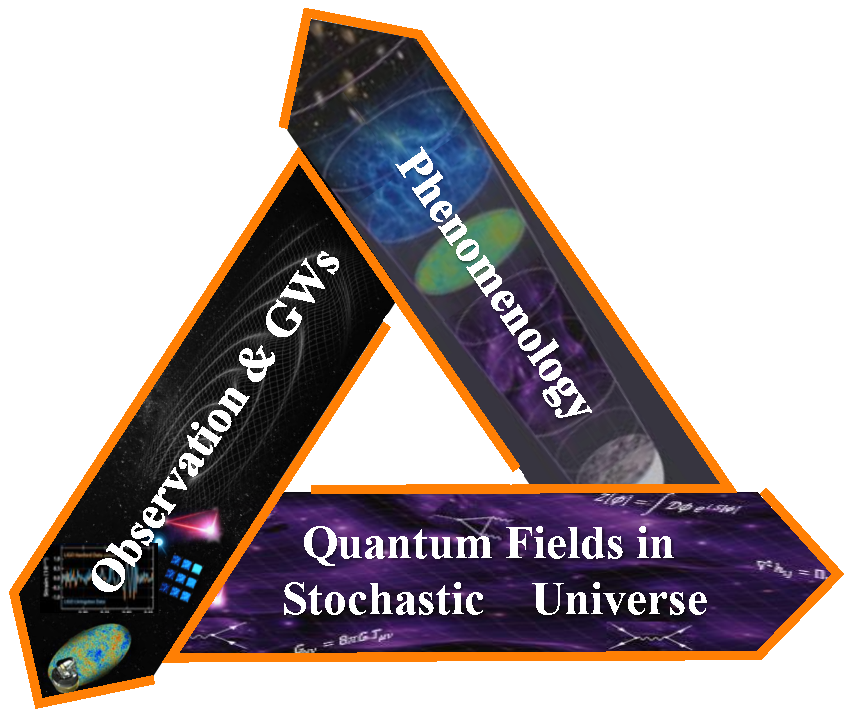
I organize my research around three connected pillars:
- Quantum field theory in stochastic cosmic backgrounds
- Particle production, relics, and gauge dynamics (Abelian & non‑Abelian)
- Gravitational-wave generation, phenomenology, and detection
Publications
All my papers, grouped by topic. Choose a topic to see its papers. INSPIRE always has my most up-to-date record.
QFT in cosmology
Quantum fields in de Sitter space and in stochastic cosmic backgrounds, and the particles they create.
- de Sitter Spacetime: Geometry, Causal Structure, and Quantum Fields
arXiv:2609.30453 (2026)
- Stochastic Schwinger Effect: de Sitter and beyond
arXiv:2608.19378 (2026)
- The Stochastic Schwinger Effect
JHEP 03 (2026) 043, arXiv:2510.14468
- Gravitational ABJ Anomaly, Stochastic Matter Production, and Leptogenesis
Eur. Phys. J. C 86 (2026) 728, arXiv:2412.09490
- Weyl Fermion Creation by Cosmological Gravitational Wave Background at 1-loop
JHEP 01 (2025) 023, arXiv:2406.01534
- Photon Chiral Memory Effect Stored on Celestial Sphere
JHEP 06 (2023) 193, arXiv:2304.05381
- Production and Backreaction of Fermions from Axion-SU(2) Gauge Fields during Inflation
Phys. Rev. D 101 (2020) 8, arXiv:1905.09258
- Production and Backreaction of Spin-2 Particles of SU(2) Gauge Field during Inflation
JHEP 05 (2019) 174, arXiv:1808.09076
- Schwinger Effect by an SU(2) Gauge Field during Inflation
JHEP 02 (2019) 041, arXiv:1805.09318
Particle cosmology
Model building and phenomenology beyond the Standard Model: inflation driven by gauge fields, dark matter and dark energy, the origin of matter, and the signals these leave for observation.
- Gravitational Wave-Induced Freeze-In of Fermionic Dark Matter
Phys. Rev. Lett. 136 (2026) 131501, arXiv:2405.09723
- Ultra-Light Pion (ULP) and Baryon WIMPzilla Dark Matter
Phys. Rev. D 106 (2022) 9, arXiv:2205.12983
- Inflation: Theory and Observations
arXiv:2203.08128 (2022 Snowmass Summer Study)
- New Ideas in Baryogenesis: A Snowmass White Paper
arXiv:2203.05010 (2022 Snowmass Summer Study)
- The Isotropic Attractor Solution of Axion-SU(2) Inflation: Universal Isotropization in Bianchi Geometry
JCAP 09 (2021) 031, arXiv:2105.06259
- Chiral Anomaly in SU(2)R-Axion Inflation and the New Prediction for Particle Cosmology
JHEP 06 (2021) 113, arXiv:2103.14611
- SU(2)R and its Axion in Cosmology: A Common Origin for Inflation, Cold Sterile Neutrinos, and Baryogenesis
Phys. Rev. D 104 (2021) 083518, arXiv:2012.11516. Buchalter Cosmology Prize, 2021
- How Attractive Is the Isotropic Attractor Solution of Axion-SU(2) Inflation?
JCAP 09 (2020) 047, arXiv:2003.01617
- Dark Fermions and Spontaneous CP Violation in SU(2)-Axion Inflation
JHEP 07 (2020) 154, arXiv:1909.11545
- Inflato-Natural Leptogenesis: Leptogenesis in Chromo-Natural and Gauge Inflations
Gen. Rel. Grav. 50 (2018) 110, arXiv:1208.2807
- Gaugessence: A Dark Energy Model with Early-Time Radiation-Like Equation of State
Astrophys. Space Sci. 362 (2017) 53, arXiv:1510.00838
- An Effective Description of Dark Matter and Dark Energy in the Mildly Non-Linear Regime
JCAP 05 (2017) 038, arXiv:1611.07966
- Gravitational Leptogenesis in Axion Inflation with an SU(2) Gauge Field
JCAP 12 (2016) 027, arXiv:1604.06520
- Tensor Adiabatic Modes and Consistency Relations with Primordial Axion-Gauge Fields
arXiv:1612.05701 (2016)
- Axion Inflation with an SU(2) Gauge Field: Detectable Chiral Gravity Waves
JHEP 07 (2016) 104, arXiv:1604.03327
- Chiral Gravity Waves and Leptogenesis in Inflationary Models with Non-Abelian Gauge Fields
Phys. Rev. D 90 (2014) 023542, arXiv:1401.7628
- Chromo-Natural Model in Anisotropic Background
JCAP 03 (2014) 016, arXiv:1311.3361
- Gauge Fields and Inflation
Phys. Rept. 528 (2013) 161, arXiv:1212.2921. Invited review
- Slow-Roll Trajectories in Chromo-Natural and Gauge-Flation Models: An Exhaustive Analysis
Phys. Rev. D 88 (2013) 043509, arXiv:1212.6760
- Gauge-Flation: Inflation from Non-Abelian Gauge Fields
Phys. Lett. B 723 (2013) 224, arXiv:1102.1513
- Revisiting the Cosmic No-Hair Theorem for Inflationary Settings
Phys. Rev. D 85 (2012) 123508, arXiv:1203.0219
- Gauge-Flation and the Cosmic No-Hair Conjecture
JCAP 01 (2012) 016, arXiv:1109.5573
- Non-Abelian Gauge Field Inflation
Phys. Rev. D 84 (2011) 043515, arXiv:1102.1932
Gravitational waves & quantum sensing
How gravitational waves are made, what they carry and how to detect them. I also propose new detector designs based on quantum sensing.
New detector designs and quantum sensing
- Squashed Pyramid Interferometer Network (SPIN): Direct Access to Chirality of Cosmological Gravitational Waves
arXiv:2604.08471 (2026)
- QuGrav: Bringing Gravitational Waves to Light with Qumodes
Phys. Rev. Res. 8 (2026) 013140
- Terrestrial Very-Long-Baseline Atom Interferometry
EPJ Quantum Technol. 12 (2025) 42
- Terrestrial Very-Long-Baseline Atom Interferometry: Workshop Summary
AVS Quantum Sci. 6 (2024) 2, arXiv:2310.08183
- Cold Atoms in Space: Community Workshop Summary and Proposed Road-Map
EPJ Quantum Technol. 9 (2022) 30, arXiv:2201.07789
Theory, cosmology and observation
- When Geometry Radiates: Gravitational Waves in Theory, Cosmology, and Observation
arXiv:2512.21328 (2025). Invited review for the Astronomy and Astrophysics Review
- Cosmology with the Laser Interferometer Space Antenna
arXiv:2204.05434 (2022). White paper and mission proposal
- Axion Inflation with an SU(2) Gauge Field: Detectable Chiral Gravity Waves
JHEP 07 (2016) 104, arXiv:1604.03327
Also: earlier work in soft-matter physics, Chain Deformation Helps Translocation, with F. Farahpour, F. Varnik and M. R. Ejtehadi, Soft Matter 9 (2013) 2750–2759.
Puzzles of the Early Universe
Some of the big open questions my research works on, explained without equations.
-
Why is there more matter than antimatter?
The Big Bang should have made matter and antimatter in equal amounts, and the two destroy each other on contact. Yet almost everything we see is matter. Part of my work explores how quantum effects during inflation, involving gauge fields and gravitational waves, could have tipped the balance.
-
Where did dark matter come from?
Most of the matter in the Universe is invisible to us. With Joachim Kopp, I studied how gravitational waves in the very early Universe could themselves have created dark matter particles.
-
What happened before the hot Big Bang?
Many cosmologists think the Universe began with a brief burst of extremely fast expansion called inflation. My earliest work, and my PhD, looked at how gauge fields, the kind of fields that carry the forces of nature, could have driven or shaped that expansion.
-
Can we hear the beginning of time?
Light can’t reach us from the very first moments, but gravitational waves can. Some of my recent work proposes ways to tell whether these waves twist more one way than the other, which would be a fingerprint of new physics.